Lost and Found: Your Guide to Recovering Items from a Storage Auction
Lost and Found: Your Guide to Recovering Items from a Storage Auction
Middletown Self Storage
February 18th, 2026
What Happens When Your Belongings Go to Auction
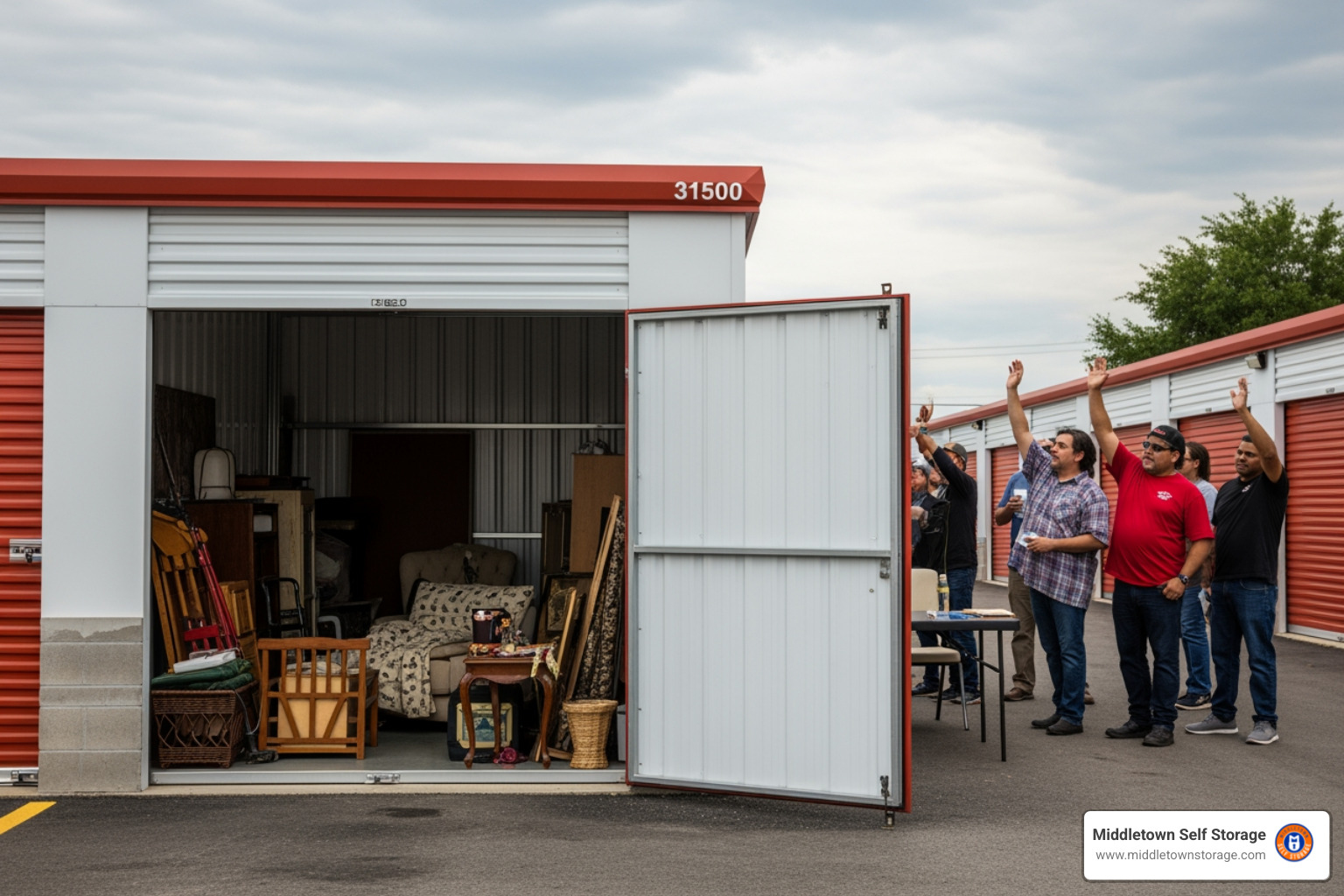
How to get your stuff back from storage auction depends on timing and action. If you act before the sale, you can pay your back rent during the redemption period. After the auction, you'll need to negotiate directly with the winning bidder to buy back your items. Quick steps to recover your belongings:
- Before the sale - Contact the facility immediately, pay all back rent plus fees, and request a payment plan if needed
- After the sale - Get the buyer's contact information from the facility manager and make a cash offer for specific items
- Document everything - Keep all receipts, communications, and proof of ownership for valuable items
- Know your deadlines - Redemption periods vary by state but typically end 24-48 hours before the scheduled auction
Missing storage payments can lead to a painful reality: your belongings sold at public auction. Storage facilities have the legal right to auction your unit when rent goes unpaid, but you're not completely out of options. The process moves quickly once you fall behind.
After missing payments, facilities send legal notices, wait through a mandatory redemption period (governed by state law), then schedule your unit for auction. Buyers at these auctions gain legal ownership of everything inside, which makes recovery challenging but not impossible. Your best chance is acting fast.
The longer you wait, the fewer options you have. Whether you're days away from an auction or just finded your unit was sold last week, understanding your legal rights and the steps available can mean the difference between losing everything and recovering what matters most.
Understanding the Storage Auction Process and Legal Rights
When we talk about storage auctions, we are looking at a process governed strictly by state lien laws. In Rhode Island, these laws are designed to protect both the facility owner and the tenant. A storage lien is a legal claim a facility has over your property when you stop paying rent.
The auction process isn't a secret or a surprise. By law, facilities must provide public notification before a sale can occur. This usually involves advertisements in local newspapers or online auction platforms. At Middletown Self Storage, we believe in transparency, which is why we provide clear information on Auctions to help both tenants and bidders understand the process. It is vital to understand that the "gavel fall" represents a hard legal boundary. Before that moment, you have the right of redemption. After that moment, the buyer holds the title to the contents.
For those looking for a deeper dive into the legalities, you can review a legal overview of storage lien laws to see how these regulations protect the industry and the consumer.
How to get your stuff back from storage auction before the sale
The absolute best way to handle this situation is to prevent the auction from happening in the first place. This is known as "curing the default." If you receive a notice of a pending auction, your first step should be to calculate your total back rent, late fees, and any auction advertising costs the facility has already incurred. Most facilities prefer getting paid over holding an auction. Auctions are a lot of work! If you can't pay the full amount immediately, contact the manager to discuss a payment plan.
However, keep in mind that once a lien has been filed, the facility is often legally required to collect the full amount to stop the auction. The "redemption period" is your golden window. This is the time between the initial notice and the actual auction date. During this time, you have the legal right to pay your debt and reclaim your unit. Once you pay, the lien is extinguished, and the auction is canceled.
Where to find state-specific storage auction laws
If you are in Middletown, Newport, or anywhere else on Aquidneck Island, you are governed by Rhode Island state statutes. You can find these through the Rhode Island State Legislature website or by looking up a summary of state-specific lien statutes.
Understanding these laws is crucial because they dictate how much notice you must be given, how the auction must be advertised, and what happens to any "surplus" funds (money made at auction that exceeds your debt). If a facility fails to follow these specific procedures, you may have grounds for legal counsel or consumer protection claims.
How to Get Your Stuff Back From Storage Auction After the Gavel Falls
If the auction has already occurred, don't panic, but do move quickly. The moment the auction ends, the winning bidder is the new legal owner of your belongings. While this sounds final, many bidders are professional resellers who are interested in the "big ticket" items and may be willing to return personal items or sell back specific pieces.
Your first point of contact is the facility manager. While they cannot give you the buyer's private phone number without permission, they can often pass your contact information along to the buyer.
Required Documentation for Ownership
If you are successful in negotiating with a buyer or if there is a dispute, you will need to prove that the items are yours—especially if you are claiming items that were not part of the auction (like certain legal documents). Be prepared to provide:
- A valid government-issued ID (Driver's License or Passport).
- Your original lease agreement from Middletown Self Storage.
- Photos of the items in the unit taken before the lien.
- Receipts or serial numbers for high-value electronics or appliances.
- A sales receipt if you end up buying items back from the auction winner.
Negotiating with the buyer: how to get your stuff back from storage auction
This is where your people skills come into play. Remember: the buyer didn't "steal" your stuff; they bought it in a legal sale. Approaching them with anger will likely result in them refusing to talk to you. Instead, try these strategies:
- The Cash Offer: Offer a fair price for the items you want back. The buyer likely wants to make a profit. If they paid $500 for the unit and you offer them $300 for just your family photos and an old sofa, they might see that as an easy win.
- Sentimental Items: Many professional bidders have a "heart" for personal items like birth certificates, family albums, and trophies. Often, they will set these aside and give them back for free or a very small fee because they have no resale value.
- Buy-Back Agreements: If you are buying back a large portion of the unit, get it in writing. A simple "bill of sale" signed by both parties protects you from any future claims that you took the items without permission.
Handling uncooperative facility managers and disputes
Most facility managers want the process to go smoothly. However, if you find a manager is being uncooperative—for example, refusing to pass your contact info to the buyer or denying you access to retrieve "non-lienable" items (like medical records)—refer back to your lease agreement. In Rhode Island, there are specific rules about what can and cannot be sold.
If a dispute arises that cannot be settled with a calm conversation, you may need to involve local authorities or a mediator. However, always try the "soft" approach first. We pride ourselves on customer service at Middletown Self Storage, and we find that 99% of problems can be solved with a simple, honest conversation.
Best Practices for Retrieving and Cataloging Items
If you’ve successfully negotiated the return of your items, you need to act fast. Most auction winners only have 24 to 48 hours to empty the unit.
Organizing and cataloging your recovered belongings
When you get your items back, don't just throw them in a truck. Use this as an opportunity to reorganize:
- Create an Itemized List: Write down everything you recovered.
- Condition Reports: Note any damage that occurred during the auction process or the move.
- Photo Documentation: Take pictures of everything as it comes out of the unit. This is helpful for insurance or future storage needs.
- Labeling: If you are moving items into a new unit at Self Storage, use a clear labeling system.
Ensuring legal compliance during item removal
When removing items, you must follow the facility's rules to avoid further fees. This includes:
- Trash Disposal: Do not leave trash in the hallways or by the dumpsters unless permitted.
- Unit Sweep: The unit must be "broom clean" to ensure the cleaning deposit is returned (to whoever paid it).
- Hazardous Materials: If you find items that are prohibited (like old gasoline or paint), ask the manager for proper disposal instructions.
Frequently Asked Questions
Can I bid on my own storage unit at an auction?
Yes, in most cases, the original tenant is allowed to bid on their own unit at a public auction. However, this is often a risky strategy. You might end up paying more at auction than you owed in back rent, and if you lose the bid, you lose the items. It is almost always better to pay the back rent before the auction begins.
What happens to personal photos and documents found in an auctioned unit?
While legal ownership technically passes to the buyer, many state laws and facility policies encourage or require the return of "personal" papers, such as birth certificates, tax records, and family photos. At Middletown Self Storage, we encourage buyers to turn these items into the office so we can attempt to return them to the original owner.
How long do I have to remove items after winning an auction?
The industry standard is usually 24 to 48 hours. If you are the original tenant who has bought back items from the winner, you are bound by the same timeline unless you sign a new lease agreement with the facility to keep the items in the unit.
Conclusion
Losing your belongings to a storage auction is a stressful experience, but it doesn't have to be the end of the story. Whether you are catching up on payments during the redemption period or negotiating with a buyer after the sale, there are clear paths to recovery. At Middletown Self Storage, we offer clean, secure, climate-controlled units in Middletown, RI, and we are dedicated to helping our customers manage their storage needs professionally.
If you are struggling with payments or have questions about our Auctions, please reach out to us. We provide free local move-ins with Surv! for new rentals and offer two convenient locations to serve Aquidneck Island, including Newport, Portsmouth, and Jamestown.
For more information on how we handle these situations, check out our FAQ or visit us today to see how we can help you keep your belongings safe and sound. Learn more about our auction policies and let us help you find the storage solution that works for you.